


Identify the language and market
Separate an original-language text, a French translation and editions produced for different countries. Give the exact title spelling, language and publisher. British and North American editions of an English-language work can differ in format, illustration, price or textual details. State which version matters instead of asking for an unspecified English copy.
Provide a complete reference
Use the ISBN when known, alongside author, title, publisher, date and format. A publication-page photograph or publisher catalogue link is more useful than a screenshot showing only a price. For a forthcoming title, identify the announced release date and market. Keep uncertain information marked as uncertain so that the shop can verify it.
Ask about the supply route
Some titles are stocked by a distributor in France; others must be imported for the order. Timing depends on supplier availability, transport and any import formalities. A title appearing on an overseas website does not prove immediate dispatch. Ask whether the estimate is based on confirmed stock or a less certain availability indication.
Get a complete price
Ask which charges are included: the book, currency conversion, transport and supplier costs. Request a total in euros and, for a special order, how long the quote remains valid. Grouping several books may change timing or cost. Compare offers only after checking the same ISBN, format, condition and included charges.
Clarify conditions before approval
Ask about any deposit, notification procedure and arrangements for cancellation, a reference error or transport damage. Do not assume that a specially imported copy has the same practical conditions as an ordinary shop purchase. Explain a gift or school deadline and agree on an alternative if the expected delivery is too uncertain.
Check the copy on arrival
Compare language, ISBN, format and physical condition with the order summary. Inspect corners, binding and supplements. For a series, check the volume number and edition so that formats match. If the reference differs, show the confirmed summary and describe the discrepancy promptly rather than silently accept another version.
Separate identification from commercial supply
A library catalogue may confirm that a language version exists; it does not establish sale in France. Ask the bookseller about the supplier, charges and timing for that reference. Do not replace an original-language text with a translation without agreement. Keep the country and language reference in your saved request.
Start with original-language departments without assuming stock
Le Failler, Kléber and Dialogues have original-language categories on their websites. These help you explore, but do not confirm every language or edition. Your enquiry should be more specific than a department name.
State text language, original title, author and format. Send the publisher’s record link or ISBN if you have found an overseas edition. Say whether you need that exact edition or can consider another.
Separate original language from publishing market
Reading in the original language and seeking a publication intended for a particular market are different requirements. Publishers may issue the same text in different formats or with different supplements. State what the final proposal must preserve.
For a course, group read or collection, also record series, volume and pagination when relevant. Ask the bookseller to confirm the proposed edition’s features; an original-language category does not resolve these differences.
Arrange handover at the right place
Dialogues has specialist branches in Brest; Kléber publishes a temporary address during work in Strasbourg. An imported book still requires a confirmed handover location: discovering a title online does not identify its collection point.
Ask where it will be available and what notification to expect. Confirm shipping arrangements before accepting them. Keep reference, medium, language and handover details together to check the received volume.
Consider alternatives while preserving the original need
If a reference cannot be obtained on the required terms, a bookseller may suggest another edition. Compare language, completeness, annotations, format and useful supplements. An alternative only helps if it preserves the reasons for your request.
Separate essential features from flexible ones. Request an explicit proposal before confirming a substitution, so you understand what changes beyond the title or cover image.
A documented visit
Ombres Blanches — Toulouse : choose the space that fits your book
Founded in 1975, Ombres Blanches describes itself as a bookshop with several specialisms, developed around literature and the humanities and social sciences. Its practical information distinguishes spaces and departmental contacts.
- Organisation
- Specialist spaces include an international bookshop and a cinema bookshop
- Monday arrangements
- The international bookshop is listed as closed on Monday morning, and the cinema bookshop all day on Monday
- Published general contact
- 05 34 45 53 33 · info@ombres-blanches.fr
Before setting out: State the subject and language you need to identify the appropriate space. Check its individual hours on the official page, especially on Mondays; the general contact does not confirm shelf stock.
Ombres Blanches — Toulouse — visitor information · consulted on 27 October 2026.
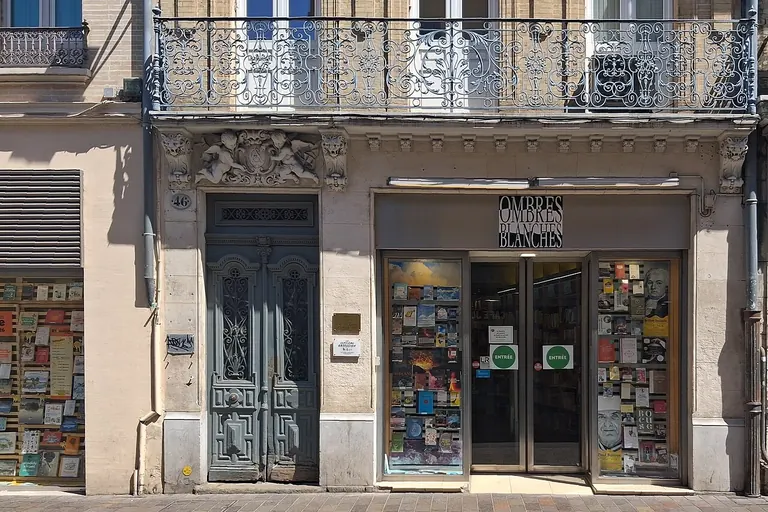
© Abdoucondorcet · CC0 · Source and original

Converted to WebP; display cropping is possible. This photograph does not confirm the current appearance of the premises.