


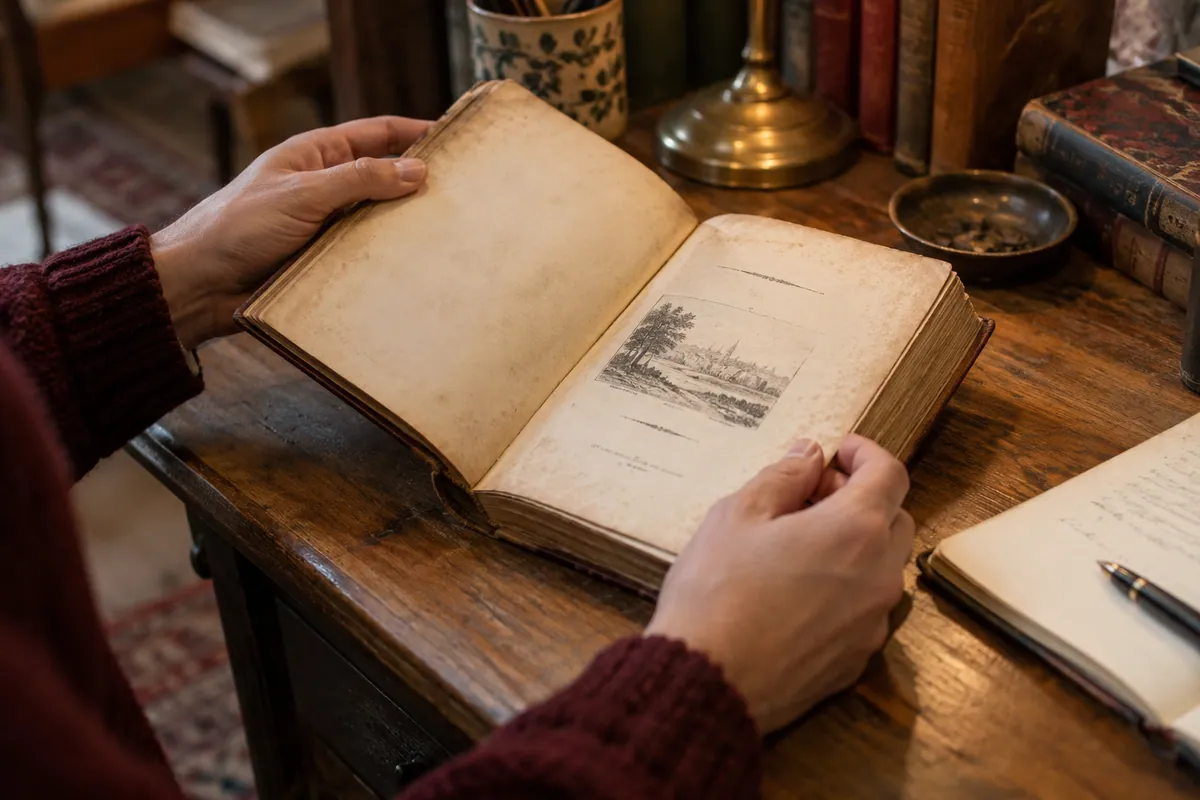
Collect stable clues
If you have the volume, photograph the title page, its reverse and the colophon clearly. Record author, translator, illustrator and publisher as printed, without correcting uncertain words from memory. A cover can change with a reprinting, so its image is helpful but often insufficient to establish the exact edition.
Explain the missing information
Say whether you need the text in any edition or a particular copy. For the latter, note dimensions, pagination, illustrations, series and binding features. A handwritten number or library shelfmark need not be a publication identifier. Photograph where the mark appears so that the professional can interpret it in context.
Try several catalogue searches
Search author and title, then title and publisher. If spelling is uncertain, use distinctive words that are clearly readable. For a translation, include the author and language. BnF and Sudoc provide complementary leads. Compare candidate records without presenting the first plausible match as a confirmed identification.
Present a checkable hypothesis
Prepare a short message with photographs, readable words and candidate record links. Explain the uncertainty: year, language, illustrator or page count. An antiquarian bookseller may compare the details with a copy for sale; a general bookseller may check a currently available edition of the text. Your purpose determines the right kind of enquiry.
Keep the search trail
Save queries and useful record links. If the work is identified but unavailable for sale, define acceptable alternatives, condition and budget before a used-book search. If reading is your aim, investigate library consultation separately. A catalogue match does not promise a purchase price, a sale route or a delivery date.