


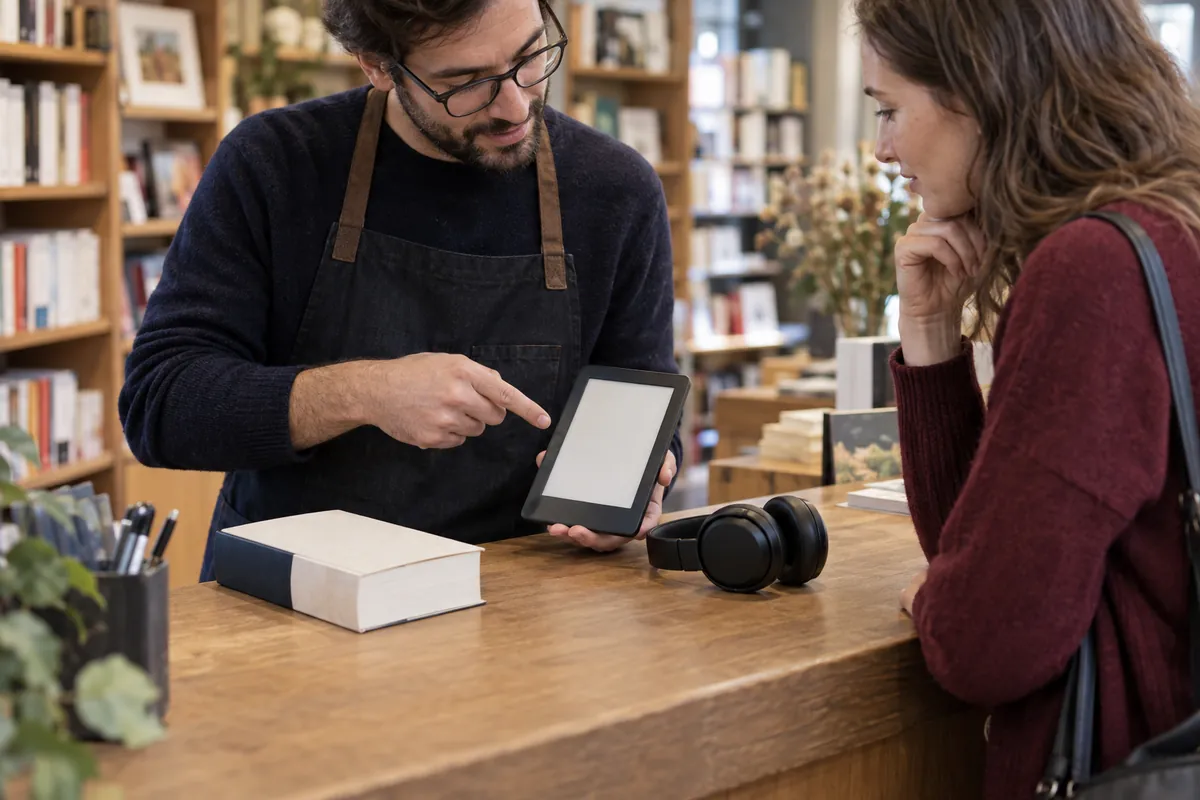
Observe how you read
Do you annotate, browse, return to passages or read continuously? Paper gives physical landmarks without a battery. Digital formats can offer text adjustment, search and portability. Audio can fit journeys and some access needs, while quick scanning or precise quotation may require other navigation. Match the format to the reading activity.
Test comfort
For print, inspect weight, opening, contrast, type size and paper opacity. For an ereader, try lighting, typography and handling. For audio, listen to a sample: voice, pace and production affect the experience. Illustrated books, manuals and heavily annotated texts may need a larger screen or work better on paper.
Understand the purchase
A physical copy and a digital licence have different arrangements. Check file format, supported devices, account requirements, downloads, technical protection and offline access. For audio, check duration and file quality. Do not assume that buying a digital version gives the same lending or resale possibilities as possessing a printed copy.
Check specific access needs
Text size, spacing and contrast adjustment can help some readers, and audio offers another way to access a work. Features vary between editions and platforms. Check navigation, required software and your own needs through an available sample. A digital label alone does not establish that the edition will be accessible to you.
Compare complete costs
Include the content, necessary equipment, accessories, replacement needs and any subscription. Already owning a compatible device changes the comparison. Investigate library access separately. A low price for one file is not necessarily economical if you rarely use the device or must pay for additional access.
Combine formats deliberately
You may prefer print for illustrated or annotated works, an ereader for travel and audio for a journey. Before buying multiple versions, check whether they serve distinct needs and whether any advertised synchronisation works in your environment. Services offered by bookshops and digital suppliers vary; confirm rather than assume compatibility.
Compare contents as well as support
A paperback, hardback or digital version may use another translation, omit images or change notes. Record the exact references. A catalogue helps distinguish versions; a trial checks comfort, navigation and annotation. For a gift, confirm the recipient’s device and preferences before choosing a platform-dependent format.